
All VR enthusiasts know the feeling of wearing a headset for long hours. The immersion is incredible, but so is the heaviness that slowly settles on your nose and cheeks. Red strap marks and facial fatigue often leave you wishing for a headset that didn’t feel like a helmet.
Meta says it has a fix. Meta’s Phoenix mixed reality headset
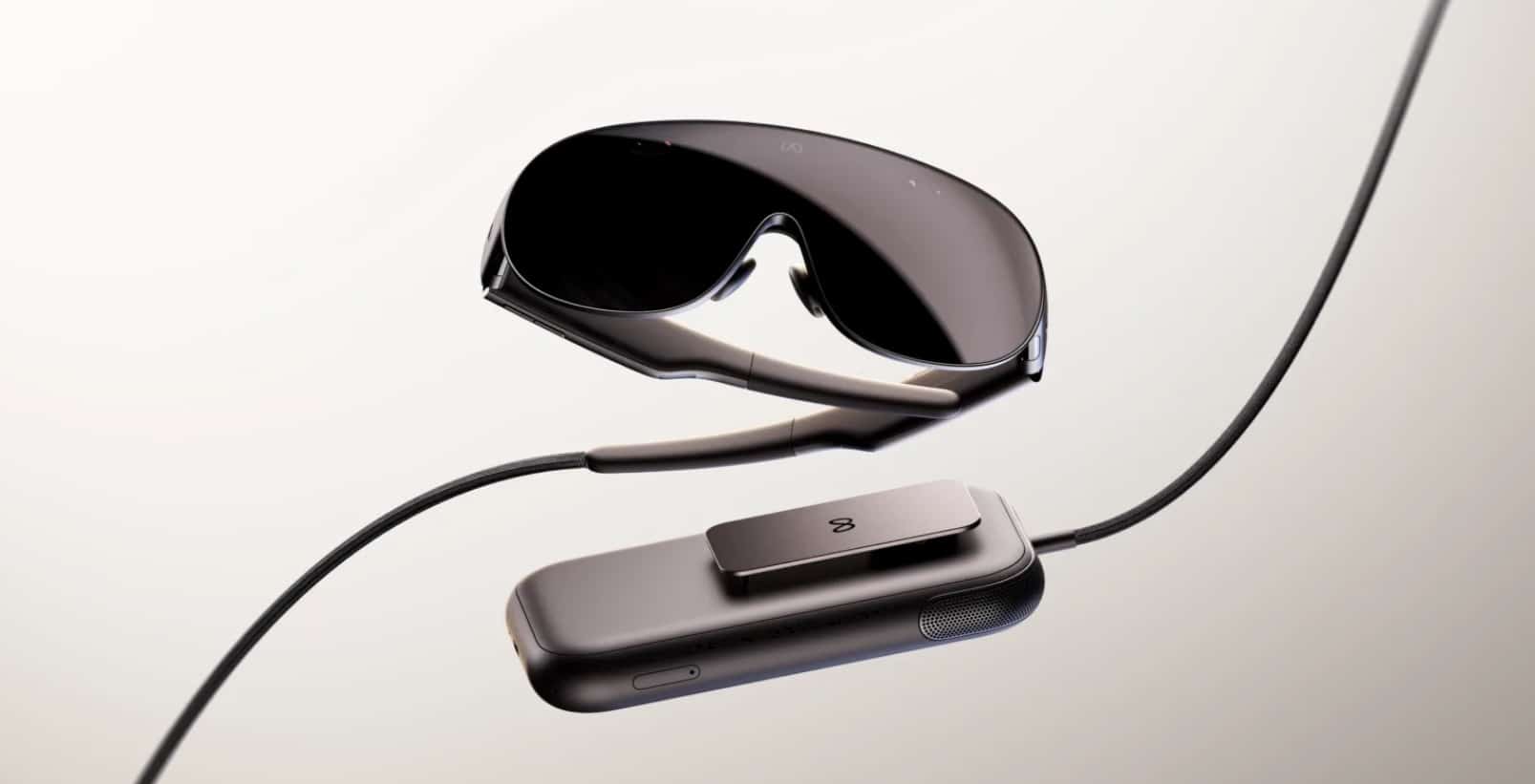
Announced at Meta Connect, the company unveiled Meta’s Phoenix mixed reality headset. Weighing roughly 100 grams, it promises a proper VR experience in a form factor much closer to regular eyewear. Priced at $1,299.99, it comes in well below the Apple Vision Pro.
There is more to these than just physical size, though. They allow you to watch, play, and work across multiple virtual displays—no physical monitor required.
Lighter by design
Most standalone headsets pack everything onto your face: processor, battery, cooling, and displays. That is the primary reason they remain bulky.
Meta took a different approach. To keep the glasses lightweight, Meta moved the battery and processor into a separate 300-gram compute puck that connects via a thin cable. You can keep the puck in your pocket or clip it to your belt. While the overall system weight remains, none of it drags down your face.
A private cinema, wherever you are
Picture yourself on a long flight, glasses on, watching a film on a massive virtual screen. That’s the core promise here.
Each eye features a micro-OLED panel displaying 2,412 × 2,288 pixels at a smooth 120Hz refresh rate. Micro-OLED technology delivers deep blacks, vibrant colors, and sharp text in an ultra-compact form factor. Meta calls this setup its 5K Infinite Display.
The trade-off is a narrower field of view—roughly 70 degrees horizontally compared to traditional VR headsets. However, for movies, browser windows, and virtual monitors, crispness and text readability matter far more than sheer width.
What about games?
Gamers haven’t been forgotten. The glasses run Horizon OS, meaning existing Meta Quest library titles will carry over. However, some action-heavy games will still require separately paired Touch controllers.
Meta is encouraging developers to lean into eye tracking and hand gestures. Look at an icon, pinch your fingers to select it—done. The limitation here remains the narrower view, meaning hard-core gamers craving full peripheral immersion may still prefer a standard Quest headset. For casual titles and quick gaming sessions, the lightweight fit will likely win out.
Calls that feel like real company
One of the headline features is Hologram Calling. Imagine video calling someone and having them appear right in front of you as a 3D figure. Eye and facial tracking drive these realistic avatars, adding genuine emotional presence for loved ones living far away.
It’s an ambitious feature where execution will be everything. Nobody wants an uncanny, glitchy digital avatar floating in a professional meeting, but if Meta gets the tracking right, this could become a primary driver for non-gaming VR adoption.
Could it replace your laptop?
Meta is also positioning these glasses as portable spatial workspaces capable of spawning multiple floating virtual screens around you.
Imagine sitting in a cafe with a coffee in hand, typing away on virtual monitors anchored in mid-air. The real test will be long-term comfort: will reading fine text, switching active windows, and typing on virtual keyboards remain comfortable over an eight-hour workday?
Project Phoenix (Meta VR Glasses): Exclusive Technical Specification Matrix
| Component Category | Exclusive Technical Specifications & Architecture |
| Ergonomics & Sizing | Available in Small and Large frame sizing; Glasses facial weight ~100g. |
| Compute & Processing Unit | Powered by Qualcomm Snapdragon Reality Elite processor (XR2 Gen 3) housed in a separate 300g pocket compute puck. |
| Memory & Storage | 12GB RAM, 128GB internal storage, plus a microSD card slot supporting up to 1TB expansion (card not included). |
| Optics & Displays | 5K Infinite Display utilizing dual micro-OLED panels; Resolution of 5.5MP (2,412 × 2,288 pixels per eye); 37 PPD pixel density. |
| Visual Performance | 120Hz refresh rate; Custom pancake lenses with integrated eye tracking. |
| Field-of-View (FoV) | Horizontal 70°, Vertical 66° (Diagonal 88°); optimized for crisp text clarity and productivity. |
| IPD & Adjustability | 56–70mm Interpupillary Distance (IPD) range, independently adjustable. |
| Tethering & Power | Optical tether connection to compute puck; Up to 3 hours of continuous media playback per charge; 45W USB-C power supply with fast-charging support during active use; USB 3.2 Gen 2 cable. |
| Display & Video Input | Full DP Alt Mode support; Real-time video streaming to Meta VR Glasses from external DP USB video sources. |
| Tracking & Cameras | 6DoF Positional Tracking; 4 dedicated eye-tracking cameras (2 per eye); Dual passthrough RGB cameras with 26 PPD, autofocus, and depth sensing. |
| Input & Control | Hand gestures (index tap, thumb swipe); Meta AI voice control; Touch Plus motion controller compatibility. |
| Ecosystem & Peripherals | Virtual desktop mirroring for Mac and PC; Bluetooth peripheral support for keyboards and gamepads; Iris-detection biometric security authentication; Horizon OS ecosystem compatibility. |
Price, release date, and rivals
The Meta VR Glasses are set to launch in spring 2027 for $1,299.99, with regional pricing and launch dates for markets like India still to be confirmed.
This positions them right between the budget-friendly Meta Quest 3 and the high-end Apple Vision Pro. While the Quest 3 remains the practical choice for dedicated gaming, Meta’s glasses carve out a unique space—prioritizing extreme wearability while preserving productivity, media consumption, and casual gaming.
Quick Hardware Comparison
| Feature | Meta VR Glasses | Meta Quest 3 | Apple Vision Pro |
| Facial Weight | 100g | 515g | 600g–650g |
| Display Tech | Micro-OLED (5K) | LCD (4K) | Micro-OLED (4K per eye) |
| Field of View | ~70° Horizontal | ~110° Horizontal | ~100° Horizontal |
| Price | $1,299.99 | $499.99 | $3,499.00 |
Are they worth the hype?
There’s a lot to like about a VR setup that doesn’t weigh down your face. The light build, sharp micro-OLED displays, spatial workspaces, and 3D calls make a compelling case.
Still, $1,299.99 is a significant investment for a category that has yet to become a daily necessity for most people. Watching a film on a giant virtual screen is impressive, but convincing people to reach for glasses every day instead of their TV or laptop remains Meta’s biggest hurdle.


 arrive in 2027 for $1,299.99. Discover how a compute puck, 5K micro-OLED, and spatial screens change VR.)